OUR WORK
Explore our recently completed projects and see the quality and creativity we bring to each endeavor. We take pride in our work and are excited to share these successful outcomes with you. Each project showcases our commitment to excellence and innovation. Take a look and get inspired!
01
STW – Bournemouth
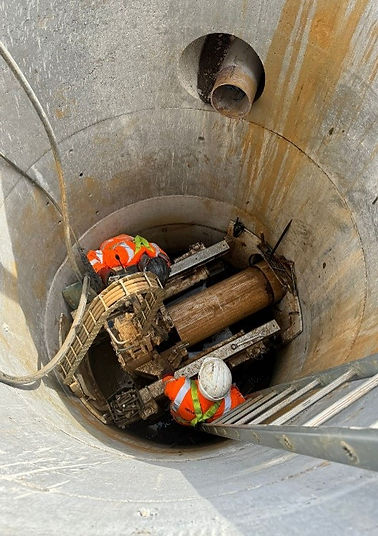
A project that required two trenchless crossings beneath access roads and infrastructure at an existing sewage treatment works to connect a new section of the plant.
The installation comprised of two 300mm clay jacking pipe crossings measuring 35m each, to connect two new storage tanks. The crossing commenced from a central launch manhole, 4m deep from surface level.
The new drainage runs were installed to line and level, as set out by the engineer for the project, using our Leica T100 theodolite targeting system.
Chiltern Thrust Bore’s involvement using our BM400 Guided Auger Boring machine, allowed the sewage treatment plant to remain open throughout the entirety of the project whilst installing the new pipework to a precise line, level and grade with no overcut of the surrounding ground.
02
East Anglia One Project – Ipswich
A project that involved installing a variety of cable ducts, to connect the newly built East Anglia One wind farm to the UK national grid. The project provides green energy from over 100 wind turbines situated in the Southern North Sea, to over 630’000 homes each year.
The project, which comprised of connecting the off-shore wind farm from Bawdsey, on the Suffolk coast, and the substation at Bramford, Suffolk, required Chiltern Thrust Bore’s services to work alongside the off-shore drilling contractors, to install a total of thirty cable ducts at two critical locations.
The first location required 2 x 400mm, 6 x 225mm, 3 x 110mm and 4 x 32mm ducts to be installed beneath the A12 trunk road that connects the A14 to the East Suffolk district. Each installation measured 195m in length. These works were crucial in order to allow the A12 dual carriageway to remain completely undisturbed whilst works progressed.
Similar to the first location, the second crossing point also required 2 x 400mm, 6 x 225mm, 3 x 110mm and 4 x 32mm ducts to be installed. This time however, beneath the A14 trunk road that connects the Ipswich to the A1, M1, M6 motorways and all inbetween. Each installation measured 120m in length. These works were crucial in order to allow the A14 dual carriageway to remain completely undisturbed whilst works progressed.


03
Road Crossing – Ipswich
A project that required a trenchless crossing beneath the road providing access to an existing retail park to provide the waste water outfall for a new McDonalds development in Ipswich.
The installation comprised of a 150mm clay jacking pipe measuring. The crossing commenced from a newly built 2.1m manhole, 2.5m deep from surface level and terminated in a temporary excavation in front of the existing outfall manhole.
Chiltern Thrust Bore’s involvement using our BM400 Guided Auger Boring machine, allowed the road to remain open throughout the entirety of the project whilst installing the new pipework to a precise line, level and grade with no overcut of the surrounding ground.
04
Network Rail Track Crossing – Mistley, Manningtree
A project that required a trenchless crossing beneath a Network rail line between Harwich International Station and Colchester.
The installation comprised of one 600mm concrete pipe to replace an existing collapsed culvert beneath the train tracks. The crossing commenced from a temporary launch shaft, excavated outside of the Track support zone and to a depth allowing for the pipe work to be installed at a depth of 6.5m beneath the railway lines.
The new concrete culvert was installed to line and level, as set out by the engineer for the project, using our Leica T100 theodolite targeting system.
Chiltern Thrust Bore’s involvement using our BPU800 Guided Auger Boring machine, allowed the train line to remain open throughout the entirety of the project whilst installing the new pipework to a precise line, level and grade with no overcut of the surrounding ground.



04
Oxford Train Station Phase 2 – Botley Road, Oxford
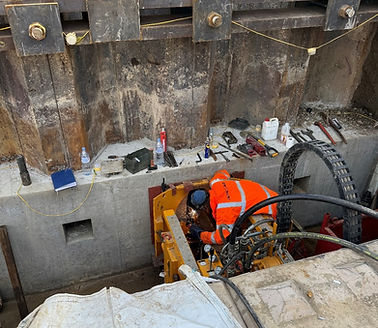
A project that required eight trenchless crossing beneath the live railway lines entering and exiting Oxford Station.
The installation comprised of eight 219mm steel sleeves, each measuring 20 meters, beneath the railway line(s). All crossings commenced from the same oversized launch shaft, excavated within the site boundary to the west of the railway allowing for the pipe work to be installed at a depth of 4.5m beneath the road level.
The installations were used as sleeves for tie-bars for future earthwork support. The sleeves were installed to the levels set-out by the engineer for the project, using our Leica T100 theodolite targeting system.
Chiltern Thrust Bore’s involvement using our BM400 Guided Auger Boring machine, allowed the railway lines to remain open throughout the entirety of the project whilst installing the new pipework to a precise line, level and grade with no overcut of the surrounding ground.
05
Shaftesbury
A project that involved installing two cable ducts, to enable the removal of overhead cables for future development in Shaftesbury.
This project required Chiltern Thrust Bore’s services to install 2 x 355mm od ducts, measuring 220m each, down a steep embankment to allow for existing overhead cables to be installed within.
Each installation was successfully installed to the required line, level and gradient as set out by the Client’s engineering team. Chiltern Thrust Bore’s Digitrak F5 tracking unit was utilised to accurately locate the drilling equipment for both bores. Excess drilling fluid was pumped from both launch and reception pits using bentonite pumps, to a central bund where the slurry was removed from site and disposed.
Upon successful installation, a pipe crawler was inserted into each pipe to confirm the structural integrity of the pipework had been maintained during installation.